
CradlePoint
Start Free → Become an Operator → Run the Archive
A myth-tech horror TTRPG with live digital table tools.
CradlePoint removes the paper, pencils, bookkeeping, and physical dice from pen-and-paper roleplaying without removing the people, choices, or consequences.
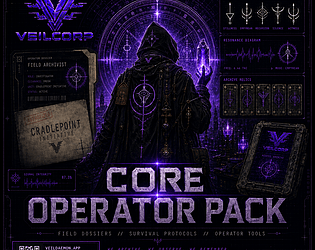
Operators get a living digital dossier.
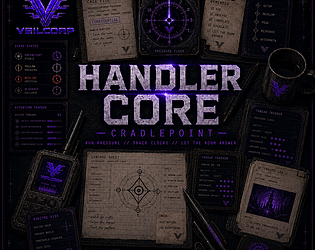
Handlers get a guided control room.
New players can create a complete, rules-valid character without reading or understanding the rules first.
You can still print everything. You just do not have to.
Build a Character Without Learning the Rules First
The interactive Operator screen is mathematically and programmatically bound to the CradlePoint ruleset.
Costs, limits, prerequisites, compatibility, progression, and available choices are enforced while you build. The interface only permits valid selections.
No illegal builds. No overspending points. No missed prerequisites. No experienced player required to audit the sheet before play.
You do not have to understand every rule before making a meaningful choice. You can learn CradlePoint by playing it.
Play Through a Living Operator Dossier
Once created, the same interface becomes your character screen at the table.
Roll tests, use abilities, and track Harm, Stability, Frequency, Presentation Load, Void, Breach, resources, recovery, and lasting consequences from one living dossier.
The interface performs the arithmetic, validates your choices, and keeps your character state inside the rules while the story changes around you.
You are not managing a spreadsheet disguised as a character sheet.
You are deciding what your Operator does next.
Run the Case Through a Guided Handler Console
The Handler does not need to memorize the system before running it.
The Handler menu is organized around what happens during play. Operators describe what their characters attempt. The Handler reports those actions through the guided menu, and the console surfaces the relevant rules, states, clocks, consequences, and next steps.
Report what the Operators attempted. Select what changed in the scene. Let the console identify the systems now in play.
Keep the table moving without stopping to search through the books.
Handlers can track scene states, Attention, pressure clocks, clues, entities, Anchor NPCs, collapse events, recovery, and aftermath from one live control room.
The Handler still controls the people, pressure, and consequences.
The console carries the administrative load.
Handler access is included with the appropriate case materials. The direct console address is not published publicly because it contains restricted tools, spoilers, and character unlock controls.
Pen-and-Paper Without the Paper
CradlePoint is still a human tabletop roleplaying game.
People speak, investigate, improvise, make choices, take risks, and live with the consequences together.
The digital system removes mechanical friction while preserving the intimacy, uncertainty, and collaborative chaos that make tabletop roleplaying matter.
We took the paper, pencils, bookkeeping, and dice out of pen-and-paper.
The consequences stayed.
Emotion Is Physics
CradlePoint is a myth-tech horror universe about making invisible pressure visible.
Overwhelm, fear, desire, denial, identity, memory, grief, intimacy, and attention do not merely influence the story.
They alter what reality is willing to do.
Operators investigate impossible events, anomalous entities, haunted locations, corrupted records, unstable systems, and breaches in consensus reality.
Violence may create an opening, but observation, containment, negotiation, stabilization, and consequence determine what survives the encounter.
What happens when the world starts responding to what people refuse to name?
Begin With NeedlePoint
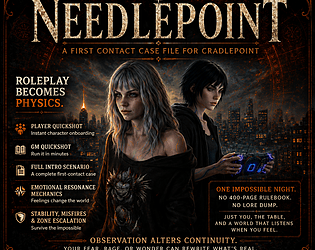
Start with a free first-contact case in which a missing streamer continues posting from an apartment floor that does not exist.
You do not need to purchase the full core books, memorize the system, or calculate a character by hand.
Open the Operator interface. Give the Handler the case materials.
Enter the signal.
CRADLEPOINT ARCHIVES // ACTIVE CASE FILES