
A double missed mistake in the opening
... an examination of a game start
Intro
A lot of attention is spent on new openings and brilliant tactics and considerably less on simple tactics that would work against noobie mistakes. But from these mistakes we noobs learn, so they must be exposed and analyzed.
This is the beginning of a game I had where the opponent sadly forgot to move and lost on time, but I find the moves that were made very informative.
Starting moves
We start with the Zuckertort opening 1. Nf3 to which I reply symmetrically with Nf6. Then 2. c4 declares the English opening, which with my knight move becomes a mouthful: A15 English Opening: Anglo-Indian Defense, King's Knight Variation. 2... g6 3. Nc3 Bg7 4. e3 - which is rare, but just as good. To which I replied with c4. My thinking was that I can castle later, as I am not exposing my king. 5. d4 cxd4 6. Nxd4.
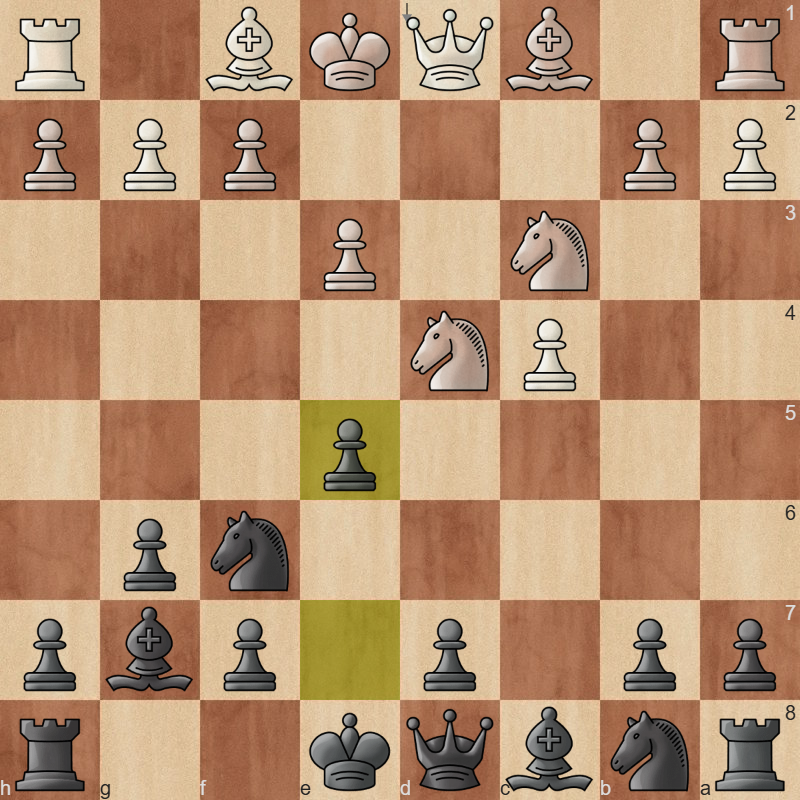
There have been some uncommon moves, but we're still in theoretical territory, with games played by Nakamura vs. Ding. The computer evaluation is dead equal. The position, I thought, felt boring and required some zing. So I moved 6...e5. In the resulting position, the eval went from 0 to +1.3. Why?
The plan
The move that both me and my opponent missed is 7. Ndb5. It's a rather basic and common scenario, because with the dark square bishop fianchettoed and the d-pawn unmoved, d6 becomes an outpost square for a monster knight. Moves like Ne8 or Bf8 are required to dislodge such a knight. And from d6 it prevents the d-pawn move, attacks b7, c8 - where it can always exchange itself for a bishop - and e8 where the king is and after short castle a rook might want to come to.
My opponent missed it, but that's expected. At 1800+ blitz+ 65% of the White players retreat the knight to f3. Only 23% do go to b5.
Computer ideas
7. Nf3 e4 - attacking the knight again. At the moment I actually missed that the knight can go to d2 and that I can't defend that pawn. I am a noob after all. The big surprise, though, is that the computer considers that to be the very best move. Not by a large margin, there are a lot of similarly rated moves, but it's one of those teaching moments when you think you are making a good move for the bad reasons, then think it was a bad move for ... also bad reasons. But why?
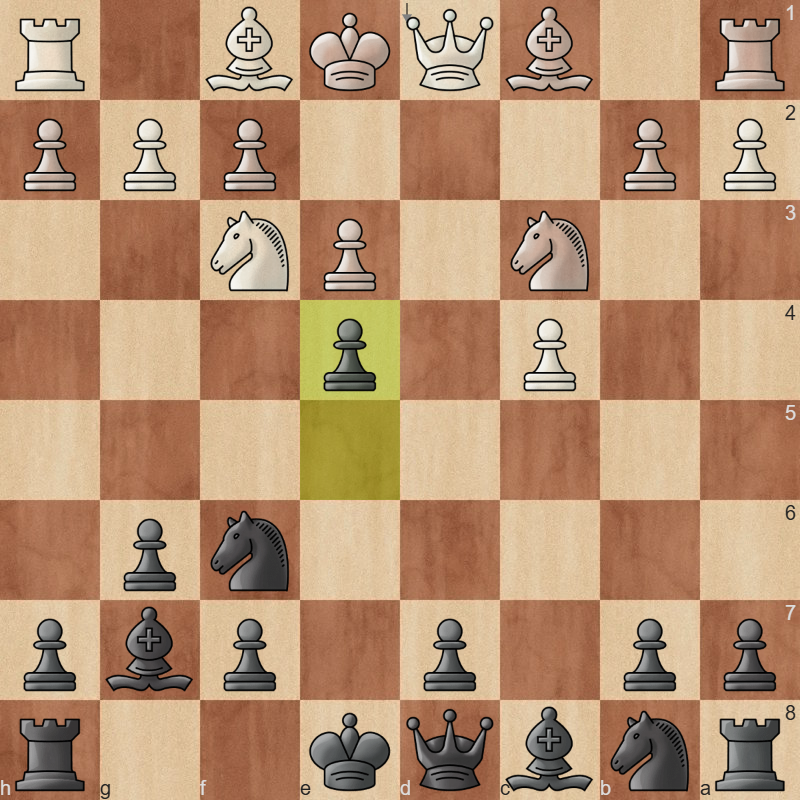
Let's continue with the computer line: 8. Nd2 d5 9. cxd5 Nxd5 10. Ndxe4 Be6 11. Nxd5 Qxd5 12. Qxd5 Bxd5 13. Nc3 Be6 14. Nb5 Na6 15. Bd2 O-O
So the computer does move the knight to d2, the e4 pawn needs defending, so it does d5, which should not work and doesn't, as cxd5, followed by a long string of exchanges, leaving each side with rooks, bishops and one knight and White having one extra central pawn. The eval is +0.22, but I wouldn't take it. It's an almost symmetrical position where Black has a knight on the rim and is a pawn down. How is this not completely losing?
 Continuation
I did not go that way and instead I've decided to abandon the pawn and try to convert it into piece activity: 8... O-O 9. Ndxe4 Re8.
I am taking the now semi-open file and attacking the knight. I am feeling very smug because I assume that, when threatened, my opponent will just take my knight and from there I had some lines that I had prepared, taking with the queen and betting the opponent will be lured to attack it with the other knight:
- 10. Nxf6+ Qxf6 11. Nd5 Qa6 12. c5 Qa5+ 13. Bd2 Qxc5 14. Nc3 d5 - this is how the game ultimately went, where Black is slightly better
- 10. Nxf6+ Qxf6 11. Nd5 Qa6 12. Nc7 Qa5+ - unlikely blunder, but totally winning
- 10. Nxf6+ Qxf6 11. Nd5 Qa6 12. Bd2 Qc6 13. Nc3 Na6 - which I thought was a pretty strangling position for White, as both flanks and the center are under relative pressure
Let's talk about those lines a little bit later and see what the position was where I was making these plans: Do you see it?
This is actually +3.2 for White with the winning move being... you may have guessed it... Nd6. But even with Nxf3, the eval is +2.3. Let's see both computer lines.
In the actual capture line, the computer would not take with the queen, but with the bishop, but after capturing with the queen, White doesn't have to be lured to attack the queen with an unnecessary knight move. Instead they move bishops on e2 and d2, castle and they're fine. Meanwhile Black has an isolated queen's pawn, a knight that will develop to a6 and a sad d-pawn who will go to d6 before anything consequential can be done. A dreadful position.
But if Black does not capture on f6 at all, Nd6 is an absolute killer. Remember that we went from something relatively equal before Re8 to +3.2 after. Re8, something so simple and clear like taking control of the semi-open file, is a complete blunder. The knight doesn't have to do anything, in fact it's kicked out of there relatively quickly, but look at the following position: It looks sad. The K-MAPS has a green K and a red MAPS. Nothing is good about Black's position here.
Humans!
But of course, my opponent did not go for a deep positional play, instead he fell right into one of the lines I had prepared and I had judged more likely. Then he forgot to move, which is a bummer.
From the other three lines I had prepared, one was an obvious blunder no one would fall into and the other one was something I felt vaguely proud of. It went like this: 10. Nxf6+ Qxf6 11. Nd5 Qa6 12. Bd2 Qc6 13. Nc3 Na6
For move 12. I had calculated that the most probable move for White would have been Bd2, and indeed that is the best computer move and my Qc6 reply is best as well. The evaluation is... +5.3 for White!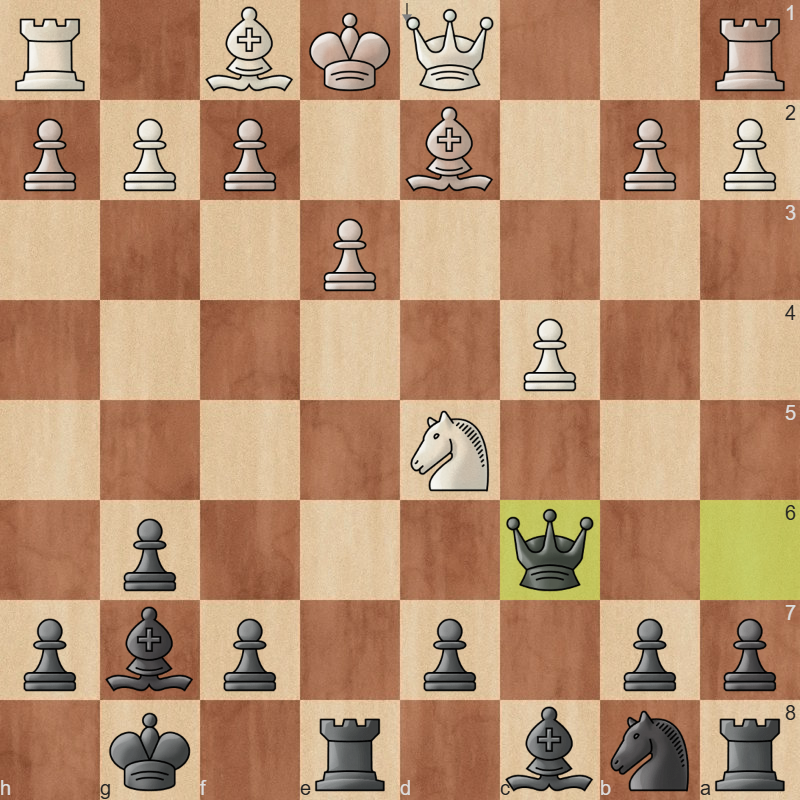 White doesn't play Nc3, but instead Bc3, challenging my bishop. And even if I take and I double isolate his pawns, it's still completely winning for White. Why?!
I left the computer burn analyzing what the hell is going on. Many a time, one of the best moves for Black was saccing the rook for the knight entrenched on d5. Because, yes, without the e and c pawns and a c4 pawn to support it, a knight on d5 is untouchable. Black needs two or three moves just to set up a capture by a minor piece.
Here is a possible line: 13. Bc3 Bxc3+ 14. bxc3 Re6 15. Qd4 b6 16. Be2 Qd6 17. Rd1 Nc6 18. Nf6+ Rxf6 19. Qxd6 Rxd6 20. Rxd6 Rb8 , leading to:
 A clear piece up and the d-pawn and light squared bishop and the rook on that side are completely blocked. It's not a simple position to analyze, even simplified to this degree, but it's completely losing for Black.
But what if the other human would have played this line and made the same assumptions as me and reached the end? Here is the position that I calculated would make almost any move impossible without losing material. I know, what a joke! It should have been the other way around with perfect play. The position would have been this: Here, White cannot move the light squared bishop for fear of losing the g2 pawn. They can't move the knight because I would take on b2. Pushing the e or c pawns gets them dead. The other pieces are blocked by all of these other pieces. Meanwhile I can move the bishop to f4, knight to b5, bring the rooks on the semi open files, exchange the d pawn, I should be golden.
The eval, though, is +1.3. Yes, White is significantly better. And the solution? White moves Rc1, overdefending the knight, then proceeds with b4. Meanwhile, on the king side, h4 and h5. The position might reach something like this instead: Rook aiming at my king on a fully open file, the other rook controlling another full open file. The queen almost centralized. One advanced pawn on the 5-th rank, a knight right there with it, while all my pieces are cowering on my side of the board, a single solitary dark squared bishop the only protection for the king. Material +2 for White, too. Yuck!
Conclusion
If you have the habit of analyzing chess games, you know Stockfish will make a fool out of you. Moves you thought good are making machines cry and moves that you thought were bad were either very good or bad for completely different reasons than what you thought. But in this case, the pattern was obvious. It was positional, but obvious.
I was so focused on how to attack and how to "get'em" that I missed the quiet moves, the ones that make the position or break it. I learned something and I hope you learned, too.
You may also like
 TotalNoob69
Delaying d6 in the Indian Defense
... valid lines, very unintuitive thibault
How I started building Lichess
I get this question sometimes. How did you decide to make a chess server? The truth is, I didn't. FM MathiCasa
Chess Football: A Fun and Creative Variant
Where chess pieces become "players" and the traditional chessboard turns into a soccer field CM HGabor
How titled players lie to you
This post is a word of warning for the average club player. As the chess world is becoming increasin… TotalNoob69
The xQc variation in the Van't Kruijs
... seems amateurish, but it is valid NM ZugAddict